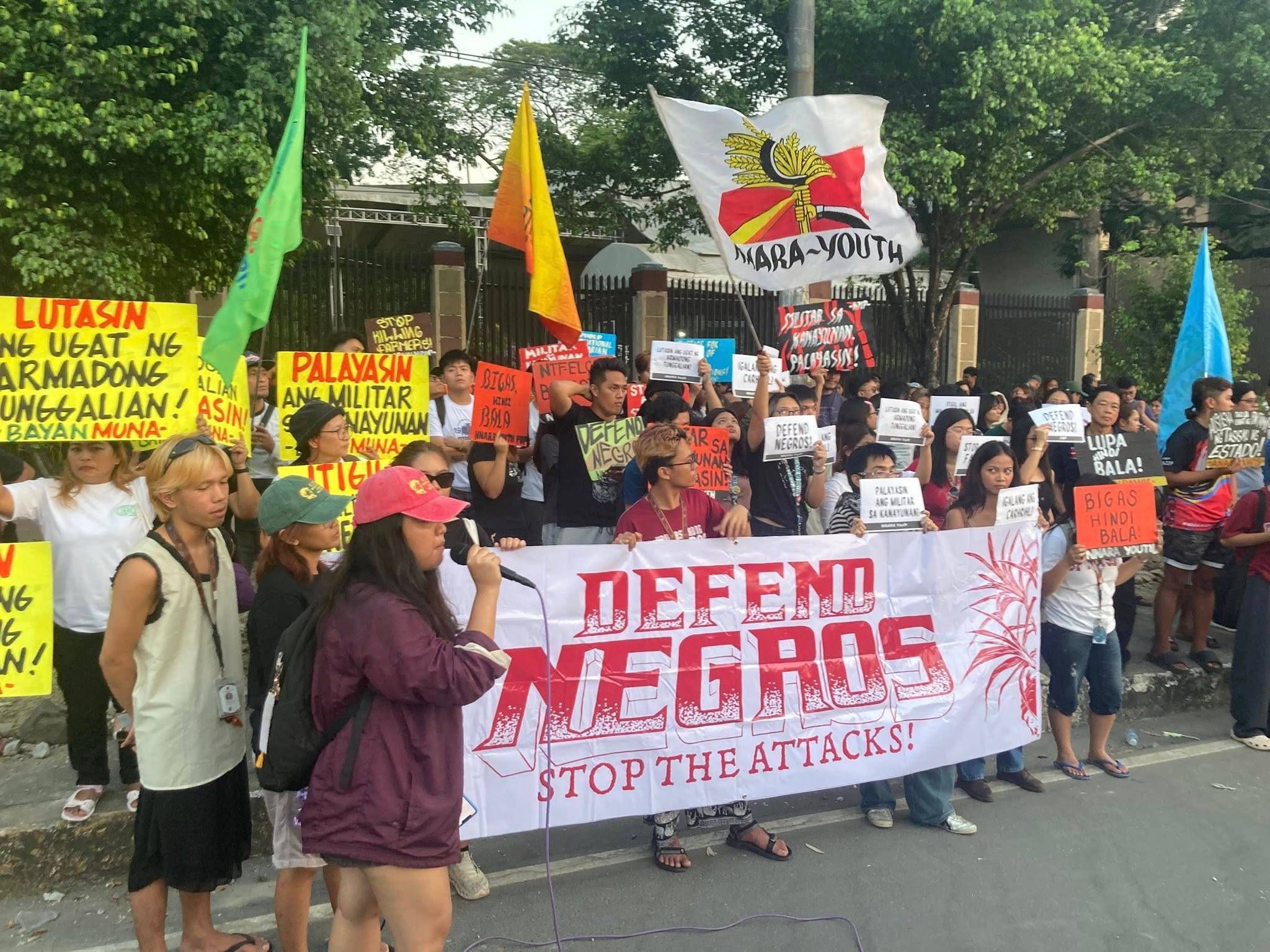
This is a sign-on statement to call for justice for the 19 Killed in Toboso, Negros Occidental as well as to stop military operations and to defend communities and the environment. The information you will provide will only be used for this purpose. The statement will be posted on social media and websites for advocacy purposes. The full statement can be found below. Thank you!
We, the undersigned organizations and individuals, strongly condemn the killing of 19 individuals in Toboso, Negros Occidental in the Philippines, in a military operation carried out by the 79th Infantry Battalion of the Armed Forces of the Philippines. The operations from April 18 to 19, 2026 have led to the forced evacuation of at least 653 residents from 168 households on April 20, 2026 in the municipality of Toboso alone [1]. This is due to the aerial bombardment, ground assaults, and fear of further violence. These actions have created a humanitarian crisis and reflect a disturbing and persistent pattern of militarization in rural communities in the country.
Available documentation from independent media, people’s organizations, and local networks shows that among those killed were farmers and land rights and environmental advocates. Named among the victims are community journalist and environmental defender RJ Ledesma, student leader and rights advocate Alyssa Alano, and land and agrarian reform advocates Maureen Keil Santuyo and Errol Wendel [2]. Testimonies from families and community members contest government claims that all those killed were combatants, asserting that several victims were civilians engaged in legitimate social, environmental, and community work. This raises serious questions about the legitimacy of the operation, the misrepresentation of victims, and the circumstances of their deaths.
The circumstances of the military operations in Toboso may constitute violations of international humanitarian law (IHL), particularly the principles of distinction, proportionality, and precaution, which obligate parties to distinguish at all times between combatants and civilians and to minimize harm to civilian populations. The targeting or misclassification of civilians, including environmental and land rights defenders, undermines these core protections and may amount to grave breaches of IHL. We are deeply concerned that this incident adds to a growing body of allegations of extrajudicial killings and excessive use of force in the context of internal armed conflict.
The violence in Negros is deeply rooted in longstanding land rights issues, social inequities, and environmental struggles. Negros Occidental has historically been dominated by large estates and plantations owned by landlords and corporations, particularly in the sugar industry, resulting in widespread landlessness and precarious livelihoods among farmers and rural workers. Peasant communities have long struggled for genuine agrarian reform, secure tenure, and living wages, while also confronting environmental degradation linked to monocrop agriculture, deforestation, and extractive activities.
In recent years, these pressures have been exacerbated by the rapid expansion of energy, mining, and agribusiness projects–including large-scale renewable energy, bioethanol, and palm oil plantations - often pushed in the name of “green development” and climate solutions. Many of these projects have been documented to proceed without meaningful consultation, free, prior and informed consent, or adequate environmental safeguards. Communities who raise concerns or oppose such projects to defend their land, waters, and livelihoods are frequently met with militarization, red-tagging, and criminalization, as state forces are deployed to secure project sites and suppress opposition. The 19 killed in Toboso were in Negros precisely because ot these systemic injustices: to immerse in peasant communities, to document environmental and human rights violations, and to accompany local struggles for land and ecological protection.
The situation in the Negros Island exemplifies a broader trend in the Philippines, where communities asserting their rights to land, environment, and self-determination are met with repression. International human rights organizations such as CIVICUS categorize the civic space in the Philippines as repressed with activists, environmental defenders, journalists, and grassroots organizations facing red-tagging, harassment, and violence [3]. These events must be understood within the wider context of the government’s “whole-of-nation approach” to counterinsurgency, which has blurred the line between armed combatants and civilians. Under this framework, civilians, legal organizations, community leaders, and even humanitarian actors are often labeled as terrorists or supporters, exposing them to surveillance, vilification, and violence [4]. This approach has enabled a climate where dissent is criminalized and military responses are prioritized over addressing the root causes of conflict, such as landlessness, environmental destruction and structural inequality.
In light of these grave concerns, we call for:
1. An independent and impartial investigation into the Toboso incident by competent human rights institutions and mechanisms, including the Commission on Human Rights of the Philippines and relevant United Nations special procedures and bodies.
2. Justice and accountability for all victims of the Toboso killings, including the prosecution of those responsible for unlawful killings and violations of international human rights laws.
3. The immediate pull-out of military troops from civilian communities and the cessation of military operations in Negros Island and all parts of the country.
4. Urgent humanitarian assistance, psychosocial support, and reparations for evacuees and affected communities, alongside conditions that enable their safe, voluntary return to their homes and livelihoods without fear of renewed violence or reprisals.
As long as structural injustices persist such as landlessness, social exclusion, and profit-driven exploitation of natural resources, people will continue to organize and speak out in defense of their rights, their environment, and their communities. It is the responsibility of the state, as the primary duty-bearer, to uphold human rights and environmental obligations, listen to its people, and address their legitimate demands, rather than serve the interests of powerful political and economic actors.
We honor those who lost their lives in Toboso. Their courage and commitment reflect a broader, legitimate struggle for human rights, environmental protection, social justice, dignity, and self-determination. We stand in solidarity with the communities of Negros and all defenders at risk, and we call on the international community to join us in demanding justice and systemic change.
[Open for endorsements from environmental, human rights, development, faith-based, and solidarity organizations, as well as individual advocates and defenders.]
International Organizations
Asia Pacific Network of Environmental Defenders
Peoples Rising for Climate Justice
Organizations from the Philippines
Center for Environmental Concerns - Philippines
Climate Change Network of Community-Led Initiatives
Environmental Defenders Congress
Kalikasan People’s Network for the Environment
[1]. PAGHIMUTAD Negros Island People's Alternative Media. (2026 April 25). Military Operation in Toboso Kills 19, Sparks Calls for Independent Probe.
https://paghimutadnegros.wordpress.com/2026/04/25/02/