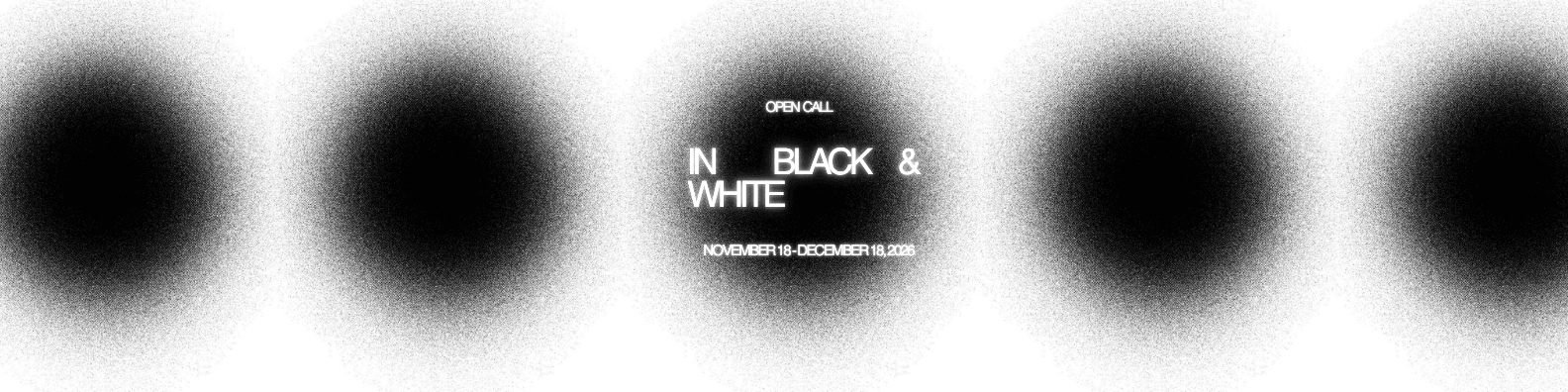
Long before color entered the artist's vocabulary, black and white were the terms of visual language itself – the first contrast, the original opposition. In early photography, ink drawing, woodcut, and film noir, black and white was never a limitation but a decision: strip away everything but light and its absence, and what remains is structure, emotion, and edge. It has always spoken in absolutes – light and shadow, presence and void, certainty and ambiguity – and for that reason, it has often been used to mark division. But contrast is not only a wall. It can also be a threshold.
In Black and White considers this duality – the way opposites can be used to separate, but also to define, clarify, and even connect. Where does black end and white begin? Is the boundary a line, or a gradient no one has looked closely enough to see? Can two things stand in total opposition and still belong to the same image, the same argument, the same room?
The exhibition treats black and white not as a stylistic constraint but as a subject in itself – gathering work that is quiet and work that is confrontational, images that resolve their contrasts and images that leave them unresolved. The aim is not consensus, but conversation: a space where opposing visual forces are placed close enough to be seen clearly, and perhaps, close enough to be seen as one.