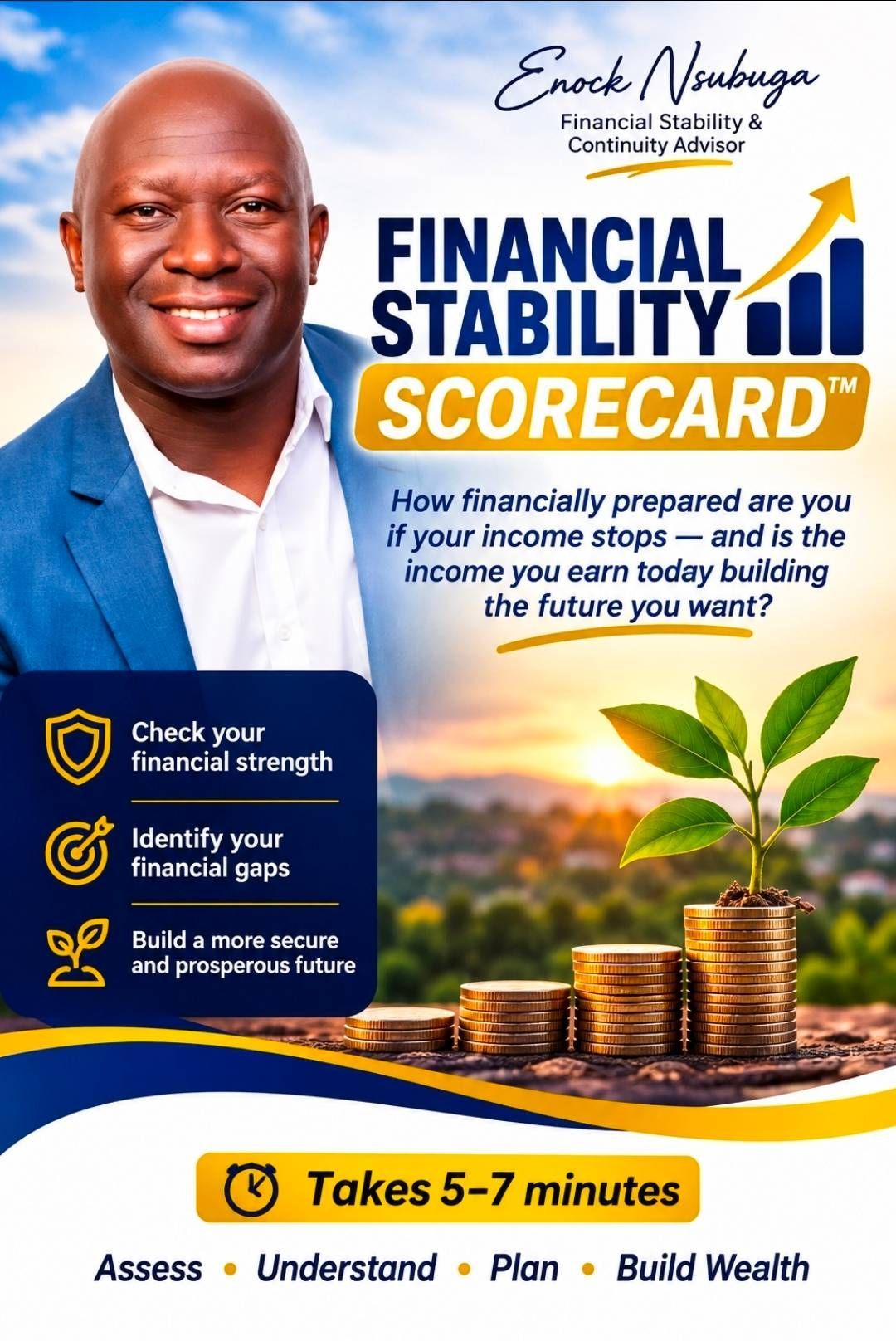
FINANCIAL STABILITY SCORECARD™
Telephone / WhatsApp Number
*
SECTION 2 — PROTECTING YOUR INCOME
1. Income Interruption: If your main income stopped unexpectedly today, for how long could you continue meeting your essential expenses without borrowing, selling assets or depending on someone else?
*
Educational note: Your expenses normally continue even when your income does not. Financial stability therefore requires a plan for surviving an interruption in income.
2. Emergency Fund: Do you currently have money specifically reserved for emergencies equivalent to at least 3–6 months of your essential expenses?
*
Educational note: Without emergency money, an unexpected expense can force you into debt or make you withdraw money intended for long-term goals.
SECTION 3 — PROTECTING THE PEOPLE AND RESPONSIBILITIES THAT MATTER
3. Family Financial Continuity: If you died, became seriously ill or permanently lost your ability to earn, is there a financial arrangement specifically designed to replace some of the income your family would lose?
*
Educational note: Savings and assets are useful, but they may not immediately replace years of future income that a household expected you to earn.
4. Education Continuity: If you are responsible for a child's education, is there a financial plan specifically designed to keep their education funded if your income stopped?
*
Educational note: Paying school fees today is different from having a system that can continue paying them when circumstances change.
SECTION 4 — CONTROLLING YOUR MONEY
5. Financial Visibility: Do you clearly know how much you earn, spend, owe, save and invest in a typical month?
*
Educational note: You cannot deliberately improve a financial position that you cannot clearly see.
6. Debt Pressure: After making your monthly debt repayments, do you still have enough money for essential expenses and consistent saving or investing?
*
Educational note: Debt becomes a financial stability problem when today's repayments repeatedly consume money needed to build tomorrow's financial security.
SECTION 5 — TURNING INCOME INTO WEALTH
7. Purposeful Saving: Do you consistently put money aside towards clearly defined financial goals with a target amount and timeframe?
*
Educational note: A goal such as “I want UGX 50 million for a property deposit within five years” is easier to plan for than simply saying “I want to save more.”
8. Financial Automation: Does part of your income automatically or consistently go towards savings, investments or financial protection before discretionary spending?
*
Educational note: Financial goals are easier to build when funding them is part of your financial system rather than dependent on what remains at the end of the month.
9. Asset & Investment Building: After meeting your regular expenses, are you consistently using part of your income to build investments or assets that could improve your future financial position?
*
Educational note: Earning income for many years does not automatically create wealth. Some of today's income must eventually become assets capable of supporting tomorrow.
10. Long-Term Investment & Retirement: Do you currently have a long-term investment or retirement plan that you contribute to consistently?
*
Educational note: One day employment or active work will stop. At that point, your lifestyle will depend on the financial resources you built while you were earning.
SECTION 6 — REDUCING DEPENDENCE ON ONE INCOME
11. Additional Income: Besides your main income, do you currently have another reliable source of income or a deliberate plan you are actively funding to build one?
*
Educational note: A second income source can reduce the financial impact of disruption to your primary income.
12. Financial Independence: Are the savings, investments and assets you are building likely to eventually generate enough financial resources to reduce your dependence on working income?
*
Educational note: The long-term purpose of wealth building is to gradually create financial resources capable of supporting you even when you are no longer earning as you do today.
SECTION 8 — YOUR FINANCIAL PRIORITY
13. What matters most to you right now?
*
14. Your Financial Target: If you selected a savings, investment, asset, education or retirement goal, approximately how much would you eventually like to build towards it?
*
Educational note: A financial goal becomes easier to plan when it has a number attached to it.
15. Your Timeframe: Ideally, when would you like to achieve or substantially address this financial goal?
*
SECTION 9 — COST OF INACTION
16. If nothing changes in this financial area over the next 12 months, what concerns you most?
*
SECTION 10 — MONTHLY FINANCIAL CAPACITY
17. If the review identifies a suitable solution for your priority, what monthly amount could you realistically consider putting aside without putting pressure on your essential expenses?
*
Educational note: A good financial plan should be sustainable. The objective is to identify an amount you can consistently maintain and potentially increase as your income grows.
18. Based on what you have discovered from this assessment, how soon would you like to start addressing your most important financial gap?
*
SECTION 12 — PERSONAL FINANCIAL STABILITY REVIEW
19. Would you like Enock Nsubuga, Financial Stability & Continuity Advisor, to contact you for a brief personal review of your Scorecard and explain possible options for addressing the gaps identified?
*
The personal review helps connect:
Your Financial Gaps → Your Financial Goals → Suitable Financial Options
How financially prepared are you if your income stops — and is the income you earn today building the future you want?
Most people know how much they earn. Fewer know whether their current financial system can protect their lifestyle, absorb emergencies, support their family and gradually build wealth.
The Financial Stability Scorecard™ is a short financial assessment designed to help you identify where you are financially strong, where you may be exposed and which areas may require attention.
Estimated completion time: 5–7 minutes. Your answers will help generate your Financial Stability Score and guide any recommendations made after the assessment.